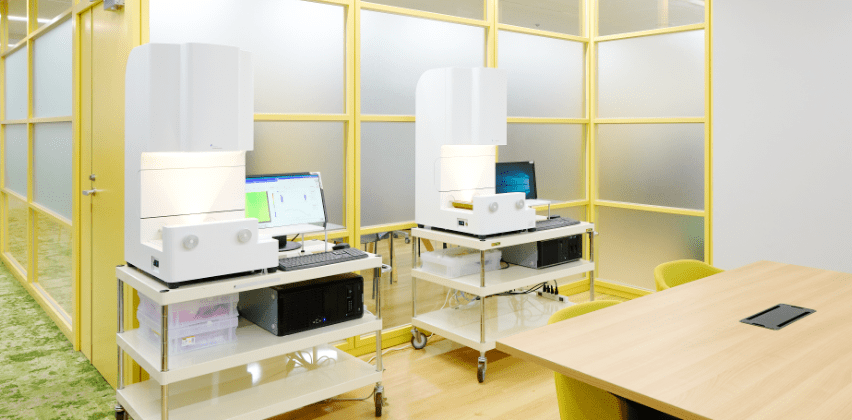
Capillary Electrophoresis System Agilent 7100 Principle
Here is an overview of the operating principle of the Capillary Electrophoresis System Agilent7100.
Principle
Principle and procedure
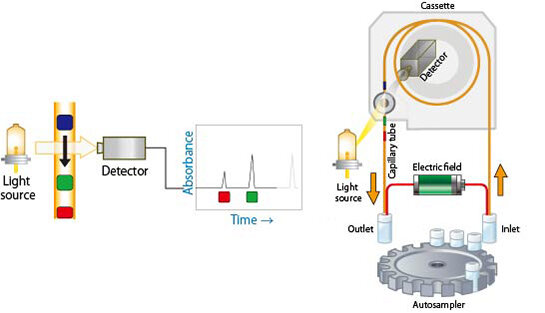
Capillary electrophoresis is a qualitative and quantitative analytical method of the separated components by performing electrophoresis in a capillary tube with an inner diameter of 100 μm or less.
[Procedure]
- Fill the capillary tube with the migration solution.
- Inject the sample into the capillary tube.
- Immerse both ends of the capillary tube into the migration solution and apply a high electric field.
- Each component is separated while migrating by electrophoresis.
- Each component is recorded as a peak in the order of reaching the detector.
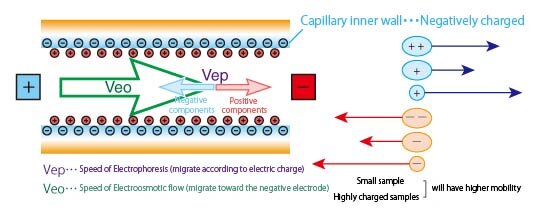
Electro-osmotic flow acting as a pump
Normally, the inner wall of a capillary tube is negatively charged by the silanol group, which causes cations in the liquid to collect on the wall. When an electric field is applied, these cations migrate to the negative electrode with the solvent in tow. This flow is called electroosmotic flow and acts like a liquid chromatographic (LC) pump. The sample undergoes electrophoresis while flowing with the electroosmotic flow, and each component is separated according to differences in charge and Stokes radius.
Contact
Please feel free to contact us with any inquiries or requests.
Otsuka Electronics
Members Site
The Otsuka Electronics Members Site offers the following services.
We will continue to provide a wide range of content designed to enhance your professional knowledge and support your work.
Key Features of the
Members Site
-
Download product catalogs
-
Download technical documents
-
Watch member-only videos.
Feel free to reach out with any requests or questions.