What is zeta potential?
Particles dispersed in the liquid are generally charged positively or negatively. In order to maintain electrical neutrality, ions having an opposite sign to particles gather on the surface of the particle. When a group of ions surrounds the particle surface and gathers in a spherical shape, the charged layer will be surrounded by the layer with the opposite charge. This condition is described as "an electrical double layer was formed". What electricity is stored in a condenser is considered like this.
However, the ionic layer in the liquid is not as simple as this. The distribution of ions is disturbed due to thermal motion. Therefore, the concentration of the opposite charge is high in the vicinity of the surface, and it decreases gradually as it moves away from the surface. The particles and the charged ions show the opposite distribution. In areas far enough from the particles, positive ion charge and negative ion charge cancel off to maintain electrical neutrality. For the condenser-type double layer described above, what is actually seen in the liquid is called "diffused electrical double layer". These terms describe the electrical double layer, which is the ion distribution of the opposite charged gradually blurs as it leaves the surface.
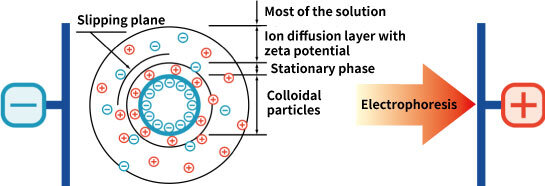
Compared to this, the ion distribution on the inner particle surface is not blurred. The diffuse electrical double layer is named with a focus on the situation of one side. This side is called the diffusion layer. The diffusion layer does not necessarily exist in the vicinity of surface. Some ions are often strongly attracted to the surface and fixed. These layers are called fixed layers. This is sometimes referred to as the Stern layer.
Mentioned at the beginning, particles dispersed in liquids often have charge. And the dispersion stability state of the particles is often determined by the charged state. In this case, what should be an indicator of the charged state of particles? Zeta potential is defined to answer this question. The problem is that it is not likely to be charged with naked particles stripped to a fixed layer, and it is unlikely to measure this directly. The charge that moves with the particles seems to directly affect the behavior of the particles, and it seems that it can be measured. It can be estimated that the particles move with the fixed layer and an inner part of the diffuse layer. The face on which this movement occurs is called a slipping plane.
Define the potential of a region that is electrically neutral enough away from the particles as zero. Zeta potential is defined as the potential of the sliding plane when measured relative to this zero point. In the case of fine particles, the higher the absolute value of the zeta potential, the stronger the repulsive force between the particles and the higher the dispersion stability of the particles. Conversely, when the zeta potential is close to zero, the particles are more likely to aggregate. Therefore, zeta potential is used as an index of dispersion stability of dispersed particles.
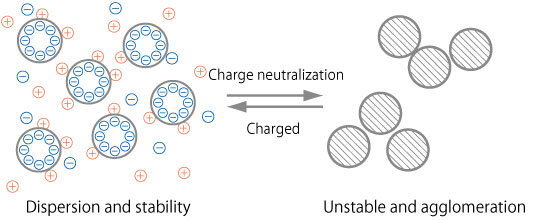
In recent years, fine particles have been often used as materials. In order to improve its functionality, research on their surface modification is actively carried out. Attempts have been made to adsorb polymer compounds, surfactants, or heterogeneous fine particles on the surface or chemically treat the surface. In addition, the conditions such as the pH value of the dispersion medium is also being examined in detail. The importance of zeta potential as an indicator of particle stability is increasing.
For more information on zeta potentials, please refer to the following books:
Fumio Kitahara, Kunio Furusawa, Masataka Ozaki, Hiroyuki Oshima,
"Zeta Potential Zeta Potential: Physical Chemistry at The Particulate Interface," Scientist, Inc., 1995.
How is the zeta potential determined?
When an electric field is applied to a system in which charged particles are dispersed, the particles move toward the electrode, since the velocity is proportional to the charge of particles, zeta potential is obtained by measuring the migration speed of particles.
The electrophoretic light scattering method is also known as the laser Doppler method, which states that “when light or sound waves hit a moving object and are reflected or scattered, the frequency of light or sound waves changes in proportion to the speed of object.” The “effect” is used to determine the migration rate of particles. When the electrophoresed particles are irradiated with laser light, the frequency of scattered light from the particles shifts due to the Doppler effect. Since the shift amount is proportional to the migration speed of particles, the migration rate of particles can be known by measuring this shift amount.
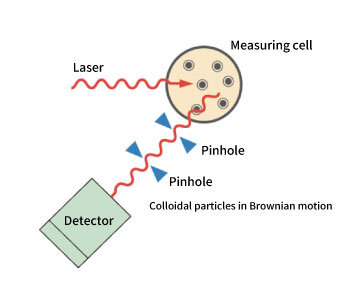
In fact, the relationship between the migration speed (V) and the Doppler shift amount (Δν) when a sample dispersed in a solvent having a refractive index (n) is irradiated with laser light of wavelength (λ) and detected at the scattering angle (θ) is expressed by the following equation.
2Vn sin(θ/2)
Δν= ─────── ・・・ (1)
λ
[n: Refractive index of solvent, θ: detection angle]
The electrical mobility (U) can be obtained from the migration speed (V) and electric field (E) obtained here.
U=V/E ・・・ (2)
Most of the electrical mobility (U) to zeta potential (ζ) can be obtained using the Smoluchowski equation.
ηU
ζ= ───── ・・・ (3)
εrε0
[η: Viscosity of solvent, εr: Specific dielectric constant of solvent, ε0: Dielectric constant in vacuum ]
In this way, zeta potential is obtained by observing scattered light from moving particles.
What is the "electro-osmosis effect" that is important for measuring the zeta potential?
The isoelectric point of quartz, which is the material of the cell, is pH 2 to 3, and the cell surface is negatively charged at pH higher than that. Therefore, positively charged ions and particles gather near the cell wall and when an electric field is applied, these ions cause a flow to the negative electrode side near the wall surface. As a result, the reverse flow to the positive electrode is generated at the center of cell in order to compensate for the flow.
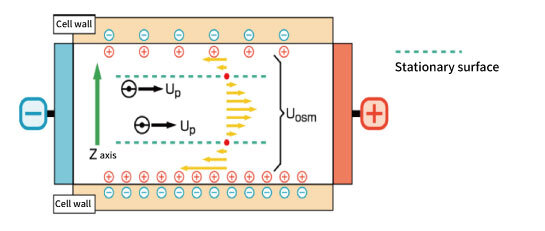
Uobs(Z) = Up + Uosm(Z)
Z: Distance from the center of cell
Uobs (Z): Apparent migration speed measured at position y
Up: True mobility of particles
Uosm: Velocity of electroosmotic flow at cell position (Z)
This series of flows is called an electroosmotic flow, and when zeta potential measurement is performed, the generation of this electroosmotic flow is unavoidable. As a result, the observed apparent electrophoresis includes the electroosmotic flow.
Uobs(Z) = AU0(z/b)2+ΔU0(z/b)+(1-A)U0+Up ・・・(4)
A = 1/ [ (2/3) - (0.420166/k) ]
k = a/b : Ratio of the length a and b of the cell cross section(a>b)
U0 : Average flow velocity of the solvent at the top and bottom of the cell
ΔU0 : Difference in flow velocity of the solvent at the top and bottom of the cell
However, the surface potential of cell changes depending on the pH of a solution, adsorption of samples and additives, sedimentation of particles, cell cleaning method, etc., and often generates a vertically asymmetric electroosmotic flow. When it becomes asymmetric, the true mobility cannot be obtained by the measurement on a stationary surface, which is generally obtained from the cell shape.
ELSZ series observe the apparent electrical mobility of particles affected by the electroosmotic flow at several points of the cell, and recalculate the stationary surface from equation (4). Therefore, the true mobility can be obtained even in a system where the electroosmotic flow is asymmetric.
In addition, this measurement method can be used to determine the charge state of the surface of cell. Using a flat surface cell, attach the flat plate sample to one side of the cell and observe the electroosmotic flow that reflects the surface potential of the flat plate sample. By analyzing this, the zeta potential of the flat plate sample can be obtained.
(Revised in September, 2022)