- 1. pH titration of alumina
- 2. pH titration of alumina, silica and mullite particles
- 3. Electrical mobility distribution measurement of mixed samples
- 4. Zeta potential measurement in non-aqueous solvent
- 5. pH titration on the surface of silicon wafer
- 6. Effect of surfactant adsorption on the surface potential of glass surface
pH titration of alumina
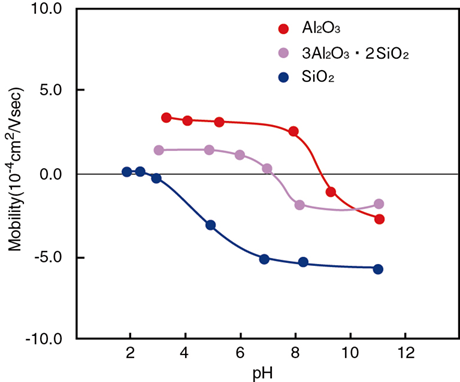
For inorganic oxide particles, the zeta potential changes significantly when the pH value of the solution changes. They have the isoelectric point where the surface potential becomes zero at a specific pH and any interfacial electrophoretic phenomena such as electrophoresis does not show. Since the electrostatic repulsive force disappears at this isoelectric point, particles is easy to aggregate. To stabilize the dispersion system, it is important to keep the pH of system as far away from the isoelectric point as possible and increase the absolute value of zeta potential.
pH titration of alumina, silica and mullite particles
pH titration measurements on alumina, silica and mullite particles were performed and the pH dependence of zeta potential was compared. Alumina and silica have isoelectric points pH 2.5 and pH 9, respectively. On the other hand, in the case of mullite particles consisting of both alumina and silica components, it has an isoelectric point between alumina and silica, and it can be seen that there is a difference in the isoelectric point between different types of mullite particles.
Electrical mobility distribution measurement of mixed samples
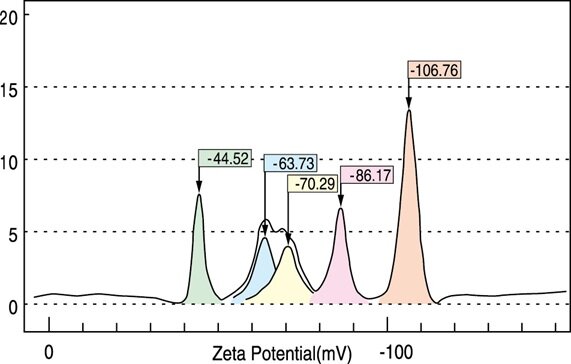
Using the electrophoretic light scattering method, when the sample is not a single component, the resulting electrical mobility distribution can be obtained with multiple peaks. Here, a mixed sample of five types of latex with different surface conditions was measured. Peaks corresponding to each latex with different surface conditions are obtained, which is in good agreement with the results obtained by measuring individually.
Zeta potential measurement in non-aqueous solvent
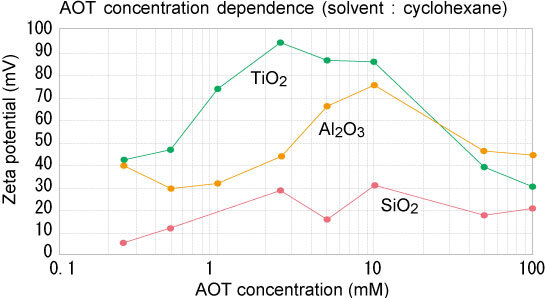
In the zeta potential measurement in a non-aqueous solvent (especially a low dielectric constant solvent), the applied voltage, the temperature uniformity inside the cell, the cell material / structure, etc. are important compared to the measurement in the aqueous solvent. Therefore, it is possible to measure stably with a specially designed cell for a low dielectric constant solvent.
Here, the effect of dispersant in the alumina-cyclohexane-AOT system was measured. When plotting the zeta potential (calculated from the mobility by Hückel's equation) with respect to the AOT addition concentration, the zeta potential changes depending on the AOT addition concentration. When 10 mM is added, the zeta potential is the largest, which indicates the excellent dispersibility.
pH titration on the surface of silicon wafer
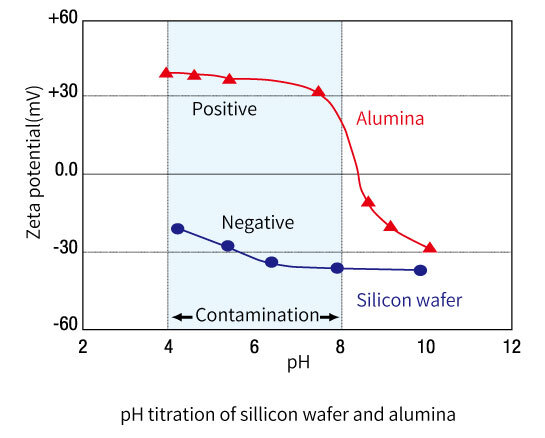
Preventing contamination on the wafer surface is one of the most important issues in the semiconductor industry. Therefore, knowing the electrostatic relationship between contaminants and the wafer surface is an effective means to prevent contamination and improve cleaning efficiency.
Here, it can be seen that the wafer surface is negatively charged at a pH range from 3 to 11. Assuming that the pollutant is alumina, it is easy to guess that it is extremely easy to adhere on the wafer surface and difficult to remove it because the wafer surface and alumina have opposite charges each other at a pH range from 3 to 9.
Effect of surfactant adsorption on the surface potential of glass surface
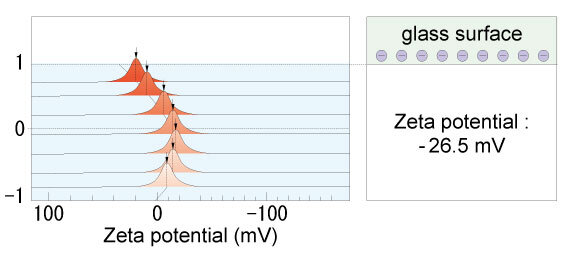
(1) Measurement result of negatively charged glass plate surface potential (Blank)
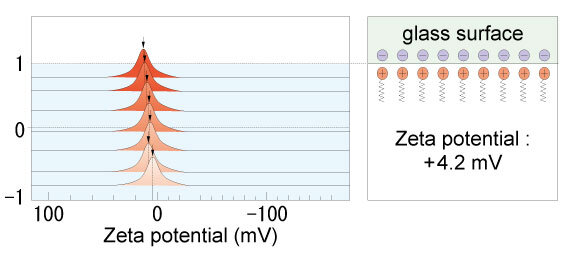
(2) Neutralization of the surface of the glass plate by positive charged CTAB.
(3) Excessive CTAB adsorption on the surface of the glass plate, resulting in positive charge.
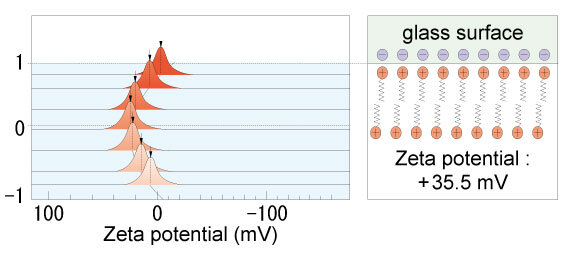
In this experiment, the substance in solution is adsorbed to the solid sample due to an electrostatic interaction and so on. The negative surface potential of glass is gradually neutralized by the adsorption of cationic surfactant. It is observed that the substance is adsorbed until it has a positive charge.
(Revised in September, 2022)