
Introduction
The word humus in gardening is often heard. The main component of humus is an organic component formed by corroding the leaves and stems of plants and is called a corrosive substance (humic acid substance). Humic acid is widely distributed in soil and natural water on the earth, and it has been said that it has a great influence on the supply of nutrients to plants. Due to its agricultural importance, research on fractionation and separation has been performed since the 1760s. In recent years, researchers have been interested in fields other than soil science, such as geochemistry, biology, environmental chemistry, and medicine, and research on their substances, roles, and applications has become active. At present, the following have been clarified regarding the properties of humic acid substances and their various effects on the environment.
[Effects on living things]- It promotes plant growth and has a microbial growth effect
- When it photochemically reacts with insoluble manganese or iron oxides, these metals are reduced and ionized to dissolve, which increases their intake efficiency.
- There are some cases where it interacts with synthetic organic substances such as pesticides by various mechanisms to reduce the toxicity of compounds. On the other hand, pesticides that are difficult to dissolve in water may be adsorbed and dispersed.
- It has physiological activities such as anticoagulant and antiviral.
- The humic substance has a surfactant activity and promotes the dispersion of oil that have flowed out to the ocean.
- It is considered that the humic substance in water is involved in the production of organic chlorides such as trihalomethane in the water treatment process.
- The humic substance forms a complex with metal ions.
Among the such effects of humic substance, we focused on the complex formation effect with metal ions. The particle size and zeta potential of the complex formed between humic acid and various metal ions were measured. Interesting results about the difference of the adsorption performance and stability of the complex are introduced.
About humic acid
Humin substances include soil (farmland, forests, mountains), peat, coal, oil, water (seawater, river water, lake water, natural water, groundwater, drainage, river mouth water), sediments (seabed, lake bottom) and so on, and they are moving. They are called terrestrial humic acid, river humic acid, and marine humic acid, respectively. In this way, humic acid is an organic substance that exists in large quantities on the earth and has various effects on the global environment. However, the humic substance is a mixture, and it is said that the structure differs depending on the collection location, and each has characteristic properties.
1) Classification of humic substancesHumic substances is defined by the International Humic Substances Society (IHSS) as follows. "A fraction that obtained by extracting soil with an alkali such as NaOH, or that adsorbed on XAD resin with natural water and eluted with a diluted alkaline aqueous solution, and this fraction is further precipitated with acid. The fraction that is precipitated or isn’t precipitated with an acid are called humic acid and fulvic acid, respectively.
”Fulvic acid is a substance that dissolves well in all solutions regardless of pH and is present in water systems such as rivers, lakes, seawater, and groundwater. It occupies most of the humin substances, and accounts for 40% of the organic substances dissolved in the river. Humic acid is insoluble in water when it is strongly acidic with a pH 2 or less, but it is soluble in strong alkalis. It has a higher molecular weight and darker color than fulvic acid, and is abundant in soil, sediments, peat, etc., and accounts for most of the organic carbon component.
The main constituent elements are carbon, oxygen, hydrogen and nitrogen, also including sulfur and phosphorus. The ratio of carbon and oxygen is high, accounting for ~50% and ~30% (wt%) of the total. Since humic substance is a mixture, the average molecular weight and molecular weight distribution are being investigated. The average molecular weights reported vary greatly but are said to be around 500 to tens of thousands. Its molecular structure is not clear because of its peculiarity of the collection area and its complexity, the typical chemical structure of humic acid is shown in Fig. 1. * (Note) XAD resin
A synthetic adsorbent that is a copolymer of styrene or acrylic and divinylbenzene and has an MR structure (Macro Reticular structure). They are white opaque spherical particles similar to ion exchange resins. Unlike an ion exchange resin, it does not have a functional group, so it is chemically extremely stable and can be used in organic solvents such as alcohol and acetone.
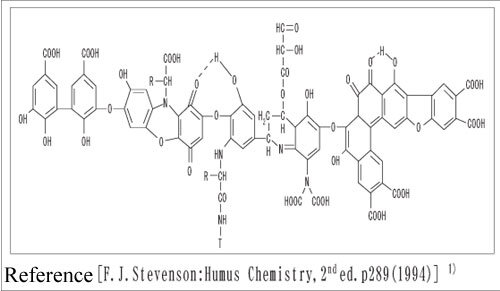 Figure 1. Conceptual diagram of humic acid
- Application to agriculture
It is said that the agricultural field is the most advanced in applied research of humic substances. Although it is often not well understood from a theoretical point of view, the surface activity of humic substances promotes the absorption of water and nutrients in crops. In addition, it promotes the retention and transportation of crop-required elements in soil because it has a complex-forming action with metals and the ability to dissolve insoluble metals. - Application to the fisheries
The surface-active action and metal complex forming action of humic substances can be used to improve water quality. - Application to the livestock industry
By mixing humic substances and their aqueous solutions with feed, it is effective in improving the meat quality of livestock, improving disease resistance, and suppressing manure odor. - Application to health-related
Humic substances is not a drug or quasi-drug, but taking an aqueous solution of humic substances or applying it to the skin is a common usage, and many examples of improvement have been reported.
The international humic substances society is a global research institute for humic substances. In Japan, various studies are being conducted by the Japan Society for the Society of Rot and Vegetables (a member of 71 organizations such as national, public and private universities, research institutes, major corporate research institutes, and private-sector rot and plant researchers) based on the World Society for the Study of Rot and Plant. The Annual Meeting of the Japanese Society of Humus is held once a year. 5) Adsorption of metal to humic acid
It is well known that humic substances forms a complex with heavy metals as described above, and it is expected to be used for soil improvement and water quality improvement in the environmental field. This time, we have taken up humic substances, which is abundant in soil, sediments, and peat among the humic substances. As shown in Fig. 2, the absorption performance of various heavy metals to humic acid varies depending on the pH, but it has been reported that it increases in the order of Pb, Cr, Cu> Cd, Zn, Ni> Co, Mn. 2)
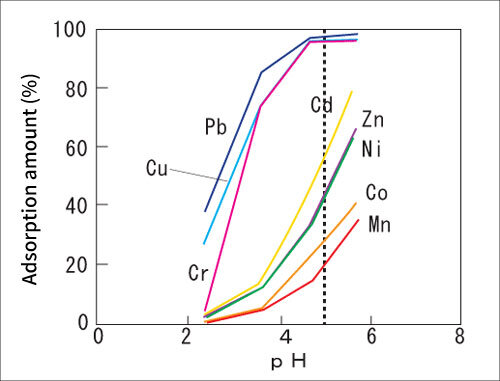 Figure 2. pH dependence of the amount of heavy metal adsorbed on humic acid of 5 × 10⁻⁴ mol / L 2)
In addition, from the structure shown in Fig. 1, it has many carboxyl groups and is negatively charged. It causes bonding with cations of various heavy metals easily and forms a complex. Zeta potential and particle size of the complex were measured, and the difference of adsorption performance was considered with their results.
2nd ed., John Wiley Sons Canada (1994)
1701-1708 (1980)
Zeta potential and particle size measurement of a complex of humic acid and heavy metal ion
Humic acid (manufactured by Wako Pure Chemical Industries, Ltd.) was dissolved in a 0.1M NaOH aqueous solution to prepare a 5 wt% aqueous solution. This solution was diluted with distilled water to make a 10 ppm solution, which was adjusted to pH 5 with 0.1M HCl. From each metal shown in Fig. 2, three types of metal ions with different adsorption abilities-Cu2+, Zn2+, Mn2+ (standard material for atomic absorption manufactured by Wako Pure Chemical Industries, Ltd., all nitrates) were adjusted to each concentration (1 to 100ppm). Each solution was mixed with a 10 ppm solution of humic acid, adjusted to pH 5, and then the zeta potential and particle size were measured. A laser zeta potential meter manufactured by Otsuka Electronics Co., Ltd. was used for zeta potential measurement, and a dynamic light scattering photometer manufactured by Otsuka Electronics Co., Ltd. was used for particle size measurement.
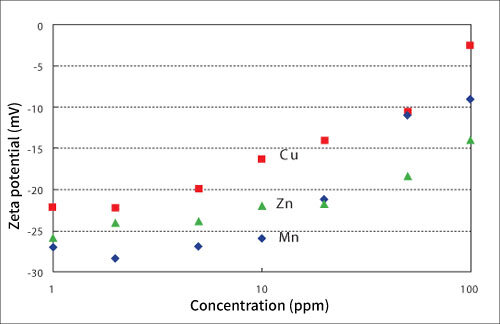 Figure 3. Zeta potential of complex of 10ppm humic acid and each metal ion
Fig. 3 shows the results of the zeta potential measurement after mixing a solution with different concentrations of each metal ion and a 10 ppm solution of humic acid. It can be seen that the zeta potential shows a negative value in all metal concentration, but its absolute value decreases as the metal ion concentration increases, and the charge approaches zero because it forms a complex with metal cations. In addition, zeta potential of each metal ion is in the order of Mn2+> Zn2+ > Cu2+ in the absolute value up to the metal ion concentration of 10ppm and corresponds well in the order of low adsorption performance shown in Fig. 2. It is thought that the higher the adsorption performance of a metal to humic acid is, the closer the charge approaches to zero due to the action of the metal cations. Fig. 4 shows the measurement result of the average particle size measured in the same way, and Fig. 5 shows the particle size distribution of Cu2+. These results indicate that there was no significant difference of particle size between each metal ion up to a metal ion concentration of about 5 ppm, but when it was 10 ppm, the average particle size increased, and the particle size distribution changed from a sharp peak to a broad peak. And the particle size also increased due to the formation of the complex and the aggregation of the complexes.
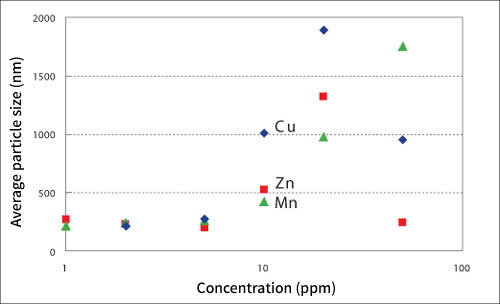 Figure 4. Average particle size of the complex of 10 ppm humic acid and each metal ion
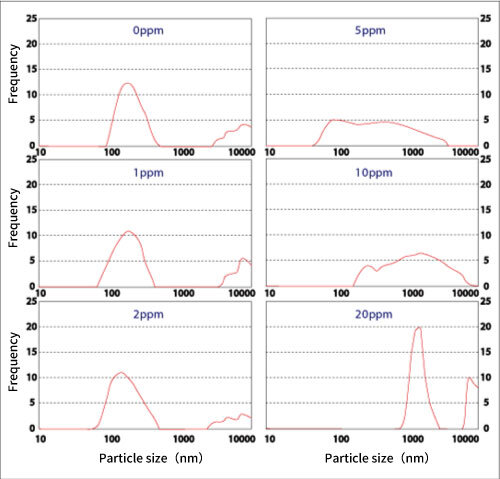 Figure 5. Change in particle size distribution (10 ppm humic acid + Cu2+ (0-20 ppm))
These results indicate that the particle size of each metal ion increased significantly in the order of Cu2+> Zn2+ > Mn2+ when the metal ion concentration was from 10 ppm to 20 ppm, and the metal ion with higher adsorption performance to humic acid has a larger average particle size. As observed in the particle size distribution, if it is added excessively, it is expected that large aggregates are formed and precipitated. However, when the metal ion concentration is close to 50 ppm, the average particle size becomes smaller. It is possible that the particle size has become too large and floating particles were measured after precipitating.
The zeta potential showed a difference between various metal ions even when the metal ion concentration was relatively low, 10 ppm or less, and the absolute value of the surface potential of humic acid gradually decreased due to the adsorption of metal ions of opposite charge. increase. On the contrary, in the region where the metal ion concentration is low, the particle size did not show a remarkable difference even though the complex was formed, and the complex increased rapidly from a certain concentration was observed, which indicates the possibility that the complexes aggregate with each other.
At the end
There is a book whose title is "Colloidal Phenomenon of Soil" 3) . It reviews soil from the perspective of colloidal science and attempts to position colloidal stability and rheology as a basis for understanding soil. The zeta potential measurement and particle size measurement of the complex of humic acid and various metals are also measurement examples in which soil (humic substances) is treated as colloidal particles. Until now, such samples have not been considered as objects to be measured by dynamic light scattering method, but it seems that they have proved to be good samples to be investigated.
Humus was born as a natural cycle, but given that it has not been fully investigated academically, it reminds us that the depth of natural phenomena is immeasurable.
Basics- “edited and written by Yasuhisa Adachi and Shingo Iwata, published by
Society Publishing Center in 2003
(Revised in September, 2022)